
Willie Horton-esque mailer attacks Lewis George for something McDuffie agrees with

Amid the 1988 presidential campaign, a PAC ran a cable advertisement flashing multiple pictures of a black man, who it dubbed “Willie” Horton.1 Horton had been in a Massachusetts prison and released on a weekend furlough program; while out, he committed a rape and murder of a white woman and her boyfriend in Maryland.
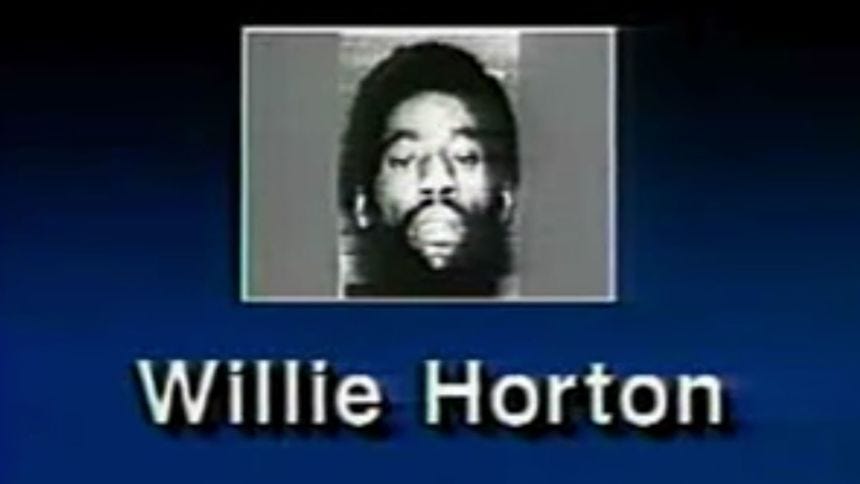
Massachusetts governor Michael Dukakis had ended this furlough program, a somewhat widespread practice at the time (Ronald Reagan had enacted a similar program when governor of California) and started by his Republican predecessor. But the George H. W. Bush campaign and affiliated PACs hounded Dukakis as “soft on crime,” an attack that may have contributed to Bush’s victory.
The ad clearly played to emotional fears about Black men and crime, and its effect on American politics lasted far beyond 1988. In The New York Times, Peter Baker wrote in 2018 that “To many African-American people, the scars from that campaign attack remain fresh. Whatever Mr. Bush’s intentions, they said, the campaign encouraged more race-based politics” around crime.
“The reason why the Willie Horton ad is so important in the political landscape — it wasn’t just about a racist ad that misrepresented the furlough process,” said Marcia Chatelain, a Georgetown University professor of African-American history who teaches a class on race and racism in the White House. “But it also taught the Democrats that in order to win elections, they have to mirror some of the racially inflected language of tough on crime.”
Michael Nelson, an editor of a book of essays on the Bush presidency called “41,” said the Horton episode led to far more overt plays to race in American politics, all the way up to President Trump. “In some ways, the Willie Horton ad is the 1.0 version of Trump’s relentless tweets and comments about African-Americans,” he said.
What this has to do with the DC mayor’s race
We know Trump plays to racial fears, but surely that isn’t a winning strategy in “Chocolate City,” in a race with two Black councilmembers as front-runners?
It seems, though, that some political operatives supporting Kenyan McDuffie looked at the Horton legacy and decided to try to get as close as they could with a mailer that hit some DC homes last week.
The mailer comes from an entity called “People for a United DC,” chaired by one Aaron Carr and treasurer Kaitlin Flint. The only donor listed on its mailer is another entity called “United DC Research Council.” Independent expenditure committees can spend unlimited money on politics but have to disclose their donors; but people can incorporate a second 501(c)(4) entity, which isn’t subject to that disclosure.
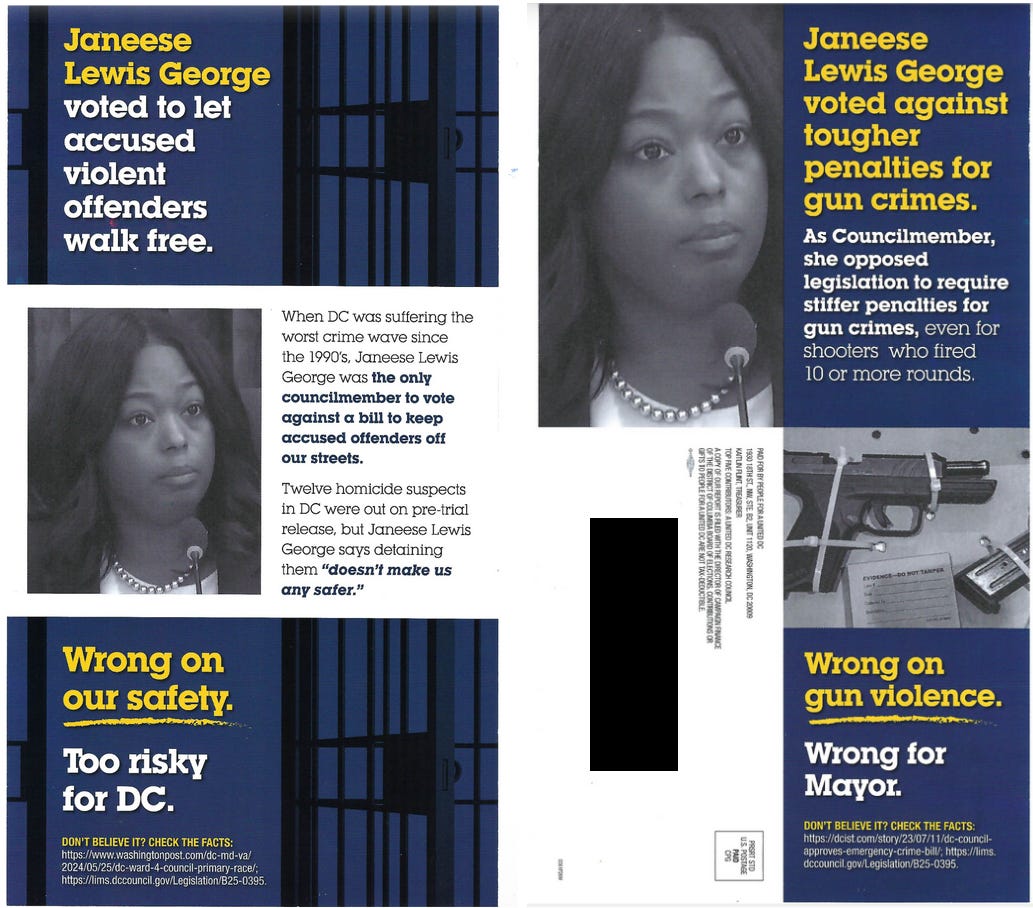
It levies two attacks on Janeese Lewis George, both around one vote on an emergency crime bill in 2023. One accuses her of voting against something that she actually supported, but she opposed the bill for a different reason and voted for it other times. The other relates to her actual reason for opposing the bill. The funny thing is, two years later, Kenyan McDuffie came to agree with her about that.
Let’s get into it.
“Wrong” on gun violence?
The claim on the right is the easy one to discuss. The bill, the Prioritizing Public Safety Emergency Act of 2023 (PPSEA), created a new offense, “Endangerment with a Firearm,” for people who discharge 10 or more rounds.
This offense had been one of many provisions in a comprehensive overhaul of DC’s criminal code, which a commission had spent 16 years developing, with input from prosecutors, police, defense attorneys, and academics. The DC Council passed the Revised Criminal Code Act (RCCA) unanimously in November 2022, but Muriel Bowser vetoed it because of a couple of provisions she disagreed with. The Council overrode her veto 12-1, but then Congress jumped on board.
With support from President Biden, 33 Democrats joined Republicans in overturning the RCCA. Democrats were afraid of being tarred as “soft on crime” despite the new criminal code being almost entirely about fixing confusing and contradictory provisions in law, not fundamentally shifting the District’s crime posture. 1988 continues to haunt national politics.
The new Endangerment with a Firearm offense was not one of the controversial elements, so the Council included this in the PPSEA, an emergency bill that would only be in effect for 90 days. Janeese Lewis George had voted for this in the RCCA multiple times and praised this provision in her January 2023 constituent newsletter. She also voted for the Secure DC act in March 2024, which made the change permanent.
So we can rate this claim from the flyer TOTALLY FALSE; Lewis George did not “oppose legislation to require stiffer penalties for gun crimes,” she supported it.
Pretrial release is good, research says
The left side of the mailer doesn’t explain what it’s talking about (because if it did, people might agree with Lewis George, as McDuffie did), but if you follow the links you can learn that the council was debating a change to pretrial release—the practice of letting people who are accused but not convicted of crimes, who are “innocent until proven guilty,” and who aren’t a danger to the community, to live and work and be with their families for the many months it can take until trial.
There are big downsides to locking people up before their trials. They likely lose their jobs, maybe their homes, maybe custody of their kids. They are in jail and more likely to build ties with other people who are involved in criminal activity. These and other factors make it more likely they’ll commit more crimes when either released after serving a sentence, or released because they were found not guilty at trial.
On the other hand, it’s true that sometimes people will commit more crimes while out pretrial, and sometimes those can be heinous. Locking people up more does make that happen less. Judges are supposed to make a decision about the risk to the community. Sometimes they will let someone out who turns out shouldn’t have been, and sometimes they will lock someone up who didn’t need to be.
Research generally confirms this pattern. A major study in this field, by Dobbie, Goldin, and Yang, looked at 300,000 court records in Philadelphia and 100,000 in Miami-Dade County from 2006 to 2014 and linked them to IRS tax data. It found that “the reductions in rearrest that accrue from incapacitating defendants pretrial are completely offset by increases in post-trial offending.” Also, “detention reduces the likelihood of employment [three to four years later] from 47% to 38% (a 20% decrease).”
Understandably, people are nervous about crime in their communities and want to see the system keeping them safe. That includes the immediate risk of someone committing a crime when released pretrial—which detention does reduce, just at the cost of future crime. Such cases can make for strong emotional Horton-esque appeals.
We could drastically err on the side of locking people up. I mean, in middle school, boys are more likely to be disruptive in class. We could simply lock all middle school boys in a room by themselves until they turn 16. That would be a terrible idea, truly immoral, and for that matter would lead to really angry 16 year old boys, but it would ensure no classroom disruption by these teenage boys!
The Council was not debating doing that. What they were debating was a set of legal changes that would lead to detaining more people pretrial.
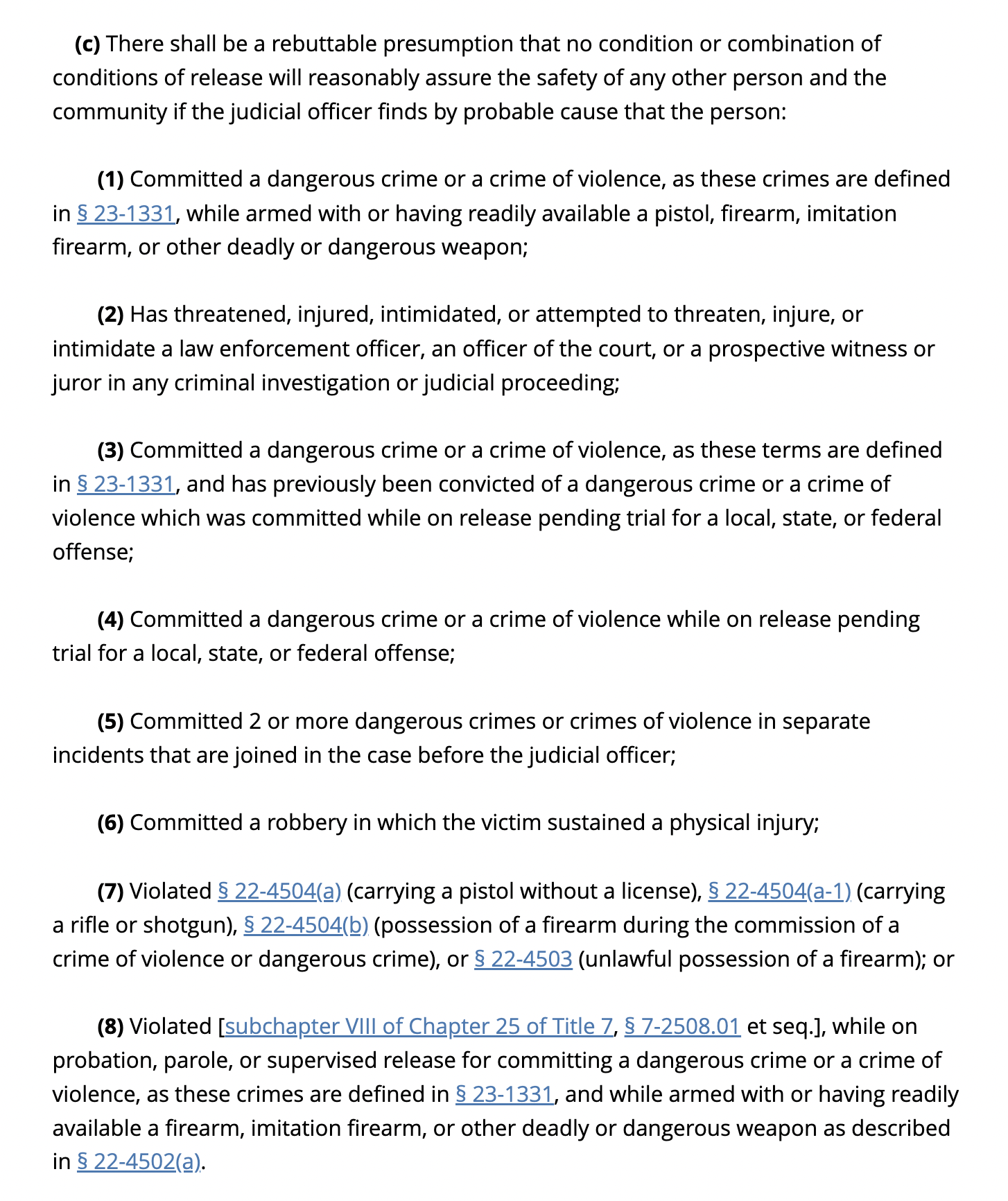
One component of the pretrial detention scheme is that some offenses carry a “rebuttable presumption” that the defendant is dangerous and should be locked up pretrial, as opposed to using other strategies like an ankle monitor. This is a thumb on the scale in favor of detention, and only applies to a set of more severe crimes. Before the PPSEA, this applied to violent offenses committed “while armed”2, people already on release for another crime, or in other circumstances.3
PPSEA expanded the “rebuttable presumption”4 to all “crimes of violence.” Besides crimes that we’d all agree are violent, like Assault With Intent to Kill While Armed, crimes like snatching a cell phone from a table, or pickpocketing, are considered crimes of violence under DC code and were affected by this provision at the time.
Lewis George opposes hastily expanding pretrial detention
Janeese Lewis George opposed the bill because of the pretrial provision and laid out her reasons in a newsletter:
Like many of us, I have been a victim of crime and I have had loved ones who have been victims of violent crime, too. And I have been on the scene of shootings in our community time-after-time speaking to victims’ devastated families and frightened neighbors. In Ward 4, we know that we need to hold people who perpetrate violence accountable and get illegal guns off our streets, while also addressing the underlying causes of violence and providing positive employment, health, and recreational opportunities to our residents and our young people that bring stability and hope to their lives.
The emergency legislation we passed made several changes that I support … [but] it irresponsibly expands pretrial detention in ways that violate due process and will make our communities less safe. …
Anyone arrested for serious offenses like homicide and armed robbery should be held before their trial. Current law already favors pretrial detention for these charges and an extensive list of violations, including any dangerous or violent crime committed with a gun or other weapon. The bill before us on Tuesday expands pretrial detention overly broadly to cover a long list of unarmed offenses [like the ones listed above]. No one is dismissing the need to enforce these offenses, but jailing defendants pretrial for these unarmed offenses without them being found guilty of anything will fail to improve public safety and will almost certainly backfire.
That is because pretrial detention is extraordinarily harmful and disruptive to the lives of people who are presumed innocent. When you are detained pretrial, you are very likely to lose your job and the economic stability it provides to you and your family. It also puts you at severe risk of losing your home if you cannot keep up with rent or mortgage payments. It separates you from your loved ones, your support network, and any treatment plans you are undergoing. And if you’re a parent, you risk losing custody of your children to the foster system. Given these impacts, it is no surprise that pretrial detention is heavily linked to higher recidivism rates — making individuals more likely to reoffend after they are released. We are talking about residents accused of unarmed offenses, who are first-time defendants, or who will later have their charges dismissed or be found not guilty. This pretrial provision will be destructive in their lives and lead to more crime in our communities that hurts all of us.
Lewis George goes on to also object to making a change to the legal standards for pretrial detention in a 90-day emergency bill. She argued that everyone from judges to lawyers to defendants need time to understand the new law, not have changes suddenly thrust on them and then perhaps expire just as swiftly.
She concludes,
Ratcheting up pretrial detention for those charged with unarmed offenses will not make us safer, but it is a formula for broken homes and increased crime. It harkens back to the failed mass incarceration polices that devastated our communities for decades. What actually deters crime is the likelihood that someone is apprehended and quickly prosecuted, yet in DC 67% of all arrests and 53% of felony arrests are not prosecuted. We need to focus on ensuring more cases are prosecuted by making constitutional arrests that do not get tossed out in court, staffing up and reaccrediting DC’s crime lab so it can collect and process the evidence needed in prosecutions, and pressuring the US Attorney’s Office to prosecute more cases when arrests are made. That is what accountability looks like.
My core is to bend the moral arc towards justice, and to me the pretrial detention component does the opposite. - Kenyan McDuffie
Kenyan McDuffie ultimately agrees
The Council passed the PPSEA and then a permanent bill, Secure DC, in 2024, which Lewis George voted for.
However, one other councilmember had doubts about pretrial detention. He decided to push for the pretrial detention provision to end after 225 days. That change passed on a 10-2 vote. He also pushed for the city to study whether pretrial detention is helping or hurting.
That councilmember was Kenyan McDuffie.
Two members also teamed up to remove another controversial provision, one that allowed police to add people’s DNA to crime databases when arresting someone, even if they’re never convicted of any crime. That amendment was co-authored by Kenyan McDuffie and Janeese Lewis George.
Secure DC passed with the 225-day sunset, and the Criminal Justice Coordinating Council, a DC agency, issued its report. That report found that detention went up substantially after Secure DC, while rearrest rates were already low and stayed low. The report wasn’t able to show a causal connection one way or the other about whether expanding pretrial detention reduced crime or not. And, there hadn’t been enough time afterward to know if detention increased criminal offending later on.
Crime did drop in the period following PPSEA and Secure DC, but it’s not possible to know what caused it. Those bills made numerous changes to the law. The police may have tried new techniques. Crime also dropped in other cities at the same time.
Still, in June 2024, Ward 2 councilmember Brooke Pinto (chair of the public safety commitee and the author of the PPSEA and Secure DC) moved to make the expanded pretrial detention permanent as part of her “Peace DC” legislation. (She changed it to no longer apply to robberies that don’t lead to injuries, like pickpocketing, and burglaries where the owner isn’t present.)
Kenyan McDuffie came down decisively against pretrial detention in that bill. He said,
The reality is that there really doesn't appear to be any evidence that the pretrial detention component is making the city safer. That's the issue I have. I can't tell you that it's making us less safe either, but my core is to bend the moral arc towards justice, and to me the pretrial detention component does the opposite.
He voted “present” on the bill’s first reading, along with Lewis George.
McDuffie is entirely correct. (Didn’t think you’d see that in Moderates For Janeese!) The national evidence doesn’t favor pretrial detention in most cases (again, none of this related to the most severe crimes or most dangerous defendants) and the local evidence doesn’t give any basis to believe otherwise.
Back to the mailer
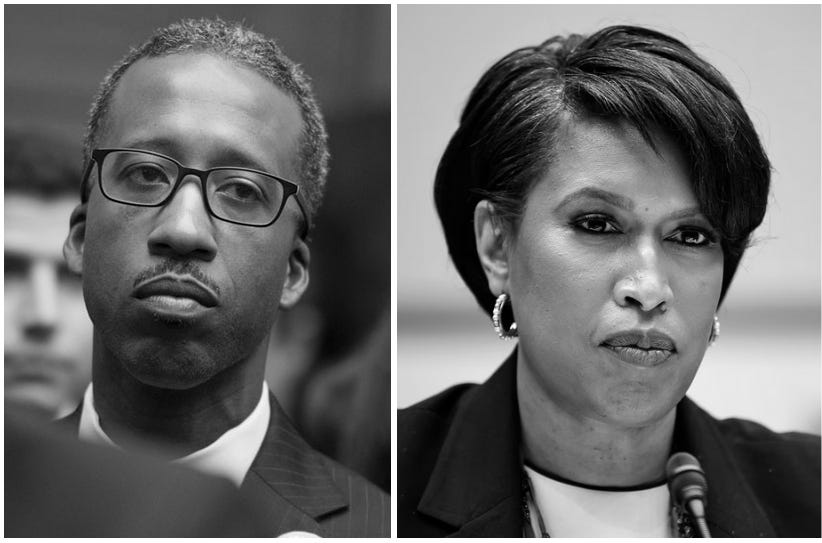
It appears someone could (but shouldn’t) make an identical mailer but with the names switched, attacking Kenyan McDuffie and Muriel Bowser instead. After all, Muriel Bowser vetoed legislation that expanded gun penalties (the exact penalties the flyer is attacking Lewis George over).
McDuffie didn’t vote for Peace DC on first reading and he spoke against pretrial detention. He said “there doesn’t appear to be any evidence [it] is making the city safer.” Just like the quote on the mailer from his opponent.
The mailer is emotionally effective, just like Bush’s attacks on Dukakis were. While there’s no booking photo of a Black man on the mailer, its authors know what image “accused offenders [on] our streets” conjures up.
On traffic planning, an area I’ve studied for many years, the typical person’s common sense tells them that adding another lane of the highway will reduce traffic. In fact, what happens is the opposite. This has led to “one more lane will fix it!” sarcastic memes among urban planning social media.
Criminal justice similarly has many places where “common sense” just isn’t right. Like increasing prison sentences doesn’t actually make crime drop, since people aren’t thinking about if the punishment is 10 vs 20 years when getting caught up in criminal activity. “Keep accused offenders off our streets” sounds good but makes crime worse and is immoral, too.5
What we need are leaders who will look at the actual data, talk to police and community leaders and kids and business owners, read the research, try solutions, evaluate them to see if they’re working, and keep working to reduce crime.
What we don’t need are shadowy “dark money” PACs trying to play on the racialized crime discourse with an imitation of the Willie Horton playbook that misrepresents Janeese Lewis George’s views on a matter where Kenyan McDuffie agrees with her. But that’s what we got anyway.
Horton later said he always had gone by William, and people had made up the “Willie” name in the campaign. “The fact is, my name is not ‘Willie.’ It's part of the myth of the case. The name irks me. It was created to play on racial stereotypes: big, ugly, dumb, violent, black — ‘Willie.’ I resent that. They created a fictional character — who seemed believable but did not exist. They stripped me of my identity, distorted the facts, and robbed me of my constitutional rights.”
Though “while armed” can be a vague standard too. Having a gun or knife is definitely “while armed,” but there have been charges for someone being armed with a “shod foot.” I was only a juror once in DC (an alternate), and the defendant was charged with an assault “while armed” and the weapon was “an unknown object.” So you can be “armed” with most any object or even an unknown one, perhaps.
Including threatening a law enforcement officer, committing 2 or more dangerous crimes in separate incidents, or violating a number of laws concerning firearm possession.
There were some changes applied to adults, and some applied to juveniles. This debate was over the adult portion, so I’ll just talk about that here; anytime I say something about the law’s changes, it’s for adults unless I specify otherwise.
The mailer also says “Twelve homicide suspects in DC were out on pre-trial release.” I haven’t been able to find any source for this other than Pinto mentioning it on the floor during the PPSEA debate. It’s unclear if these were people who’d already committed homicides, or did on release; if their offenses were among those the law changed; and if any of them turned out to be falsely accused of those homicides. Get in touch if you know.